
Reviewed · OLYMPIA TOURS
Olympia: The Famous VR Glasses Tour with Audio Guide
Ancient Olympia is famous for what remains, not what it looked like. This tour is interesting because it uses exclusive VR glasses to rebuild key monuments directly over the ruins. I like that you get a guided, stop-by-stop storyline with 15 monuments brought back to life in 3D. The main consideration is budget math, since the Olympia site entry ticket is not included and adds cost.
I also like the setup. You start at the Olympia back in time office, you get a quick hands-on demo with the audio guide, then you’re off on a self-paced route. That means you spend less time waiting for groups and more time watching the details line up with what you’re seeing in the headset.
One more thing to keep in mind: the experience is timed, so don’t plan on doing a long museum crawl too. You’ll want to use the headsets first at the archaeological site, then decide how much museum time you can fit afterward.
Key highlights at a glance
- VR reconstructions that show how monuments and spaces may have looked around 2,000 years ago
- Temple of Zeus inside the headset, including the famous statue moment
- Ancient athletes in the stadium experience, with you at the action as the Games play out
- Olympic training spaces like the gymnasium and palaestra, explained as real routines, not just ruins
- The Nymphaeum of Herodes Atticus shown as a functioning fountain, tied to water needs during the Games
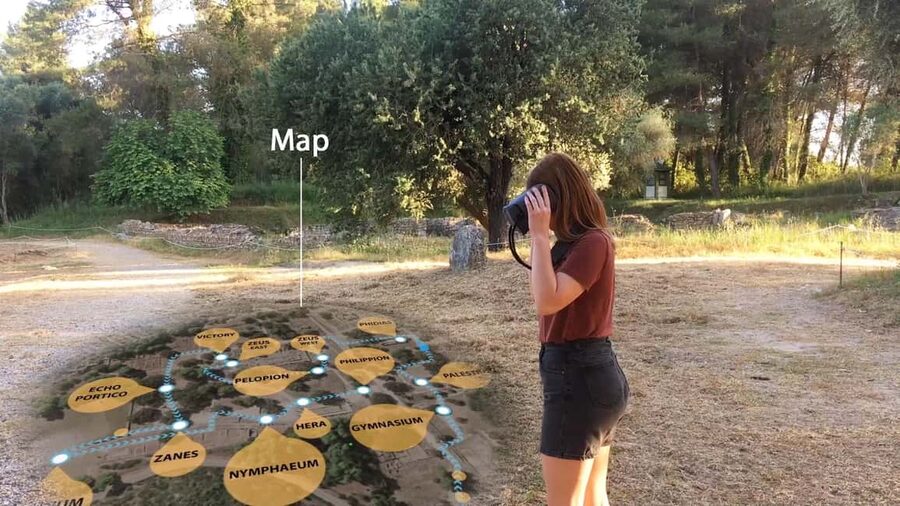
- Audio guide + virtual map to help you find the next numbered stop quickly
What the Olympia VR Time-Travel Tour Really Turns Into
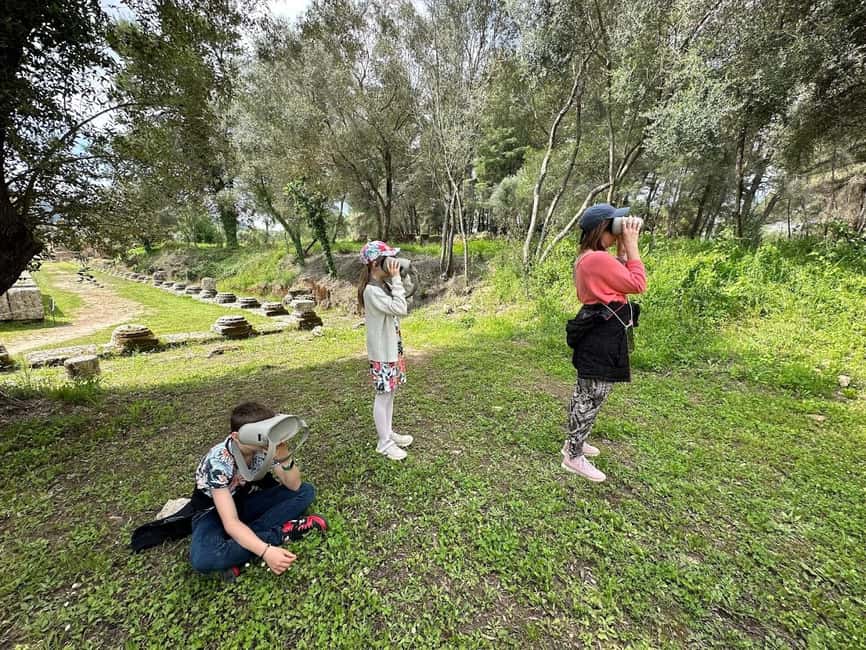
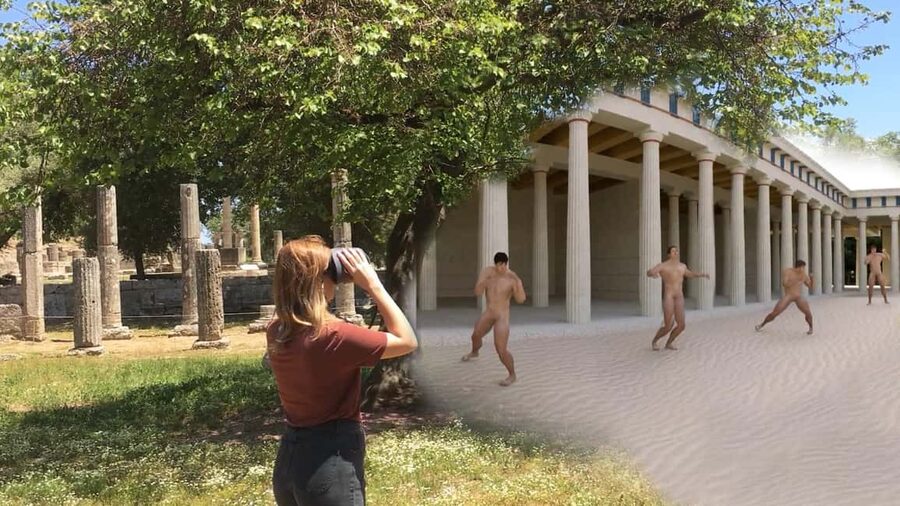
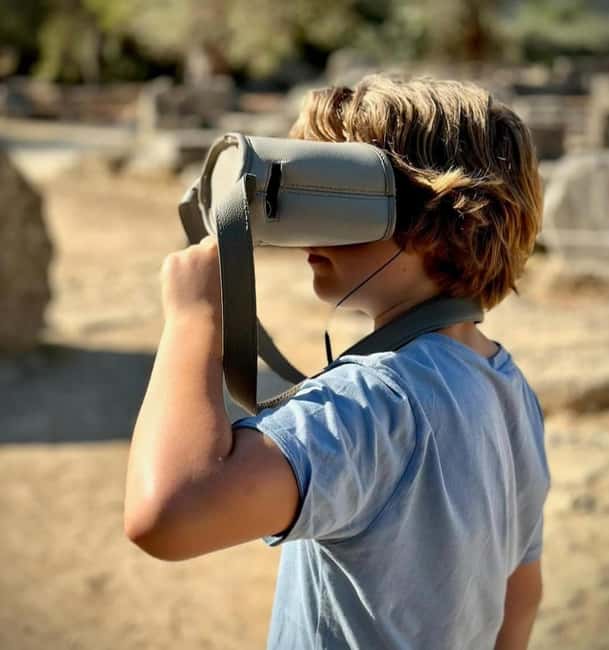
If you’ve only ever seen Olympia as scattered columns and stone fragments, you’ll feel the difference fast. With VR glasses on your face, you stop thinking in terms of leftovers. You start thinking in terms of layout, scale, and daily life. The headset overlays 3D reconstructions onto your exact surroundings, so the sanctuary turns into a place you can visualize.
The audio guide does the heavy lifting for story. It’s not a long lecture. It’s short, clear narration timed to where you are on the route. That matters because Olympia is mostly ruins, and ruins are easier to understand when you know what you are looking at. Instead of guessing, you get a guided sense of purpose, like why athletes trained where they did, or why the Temple of Zeus mattered so much.
The other smart part is pacing. This is not a racing line with a guide herding people around. You walk at your own speed, follow the virtual route, and keep the narration working for you at each monument. I like that you can take a breather, step aside for photos when you can, and replay the moment in your head when the audio finishes. It’s a different way to see Ancient Greece, and it’s especially good if you’re traveling with kids or teens who need a little momentum.
More of Ancient Olympia:
- 4-Day Classical Greece Tour: Epidaurus, Mycenae, Olympia, Delphi, Meteora
★ 4.5 · 732 reviews - Ancient Olympia: Archaeological Site and Museum Entry Ticket
★ 4.3 · 555 reviews - 3-Day Classical Greece Tour: Epidaurus, Mycenae, Nafplion, Olympia, Delphi
★ 4.5 · 342 reviews
Where You Start, and How the Whole Thing Gets Moving
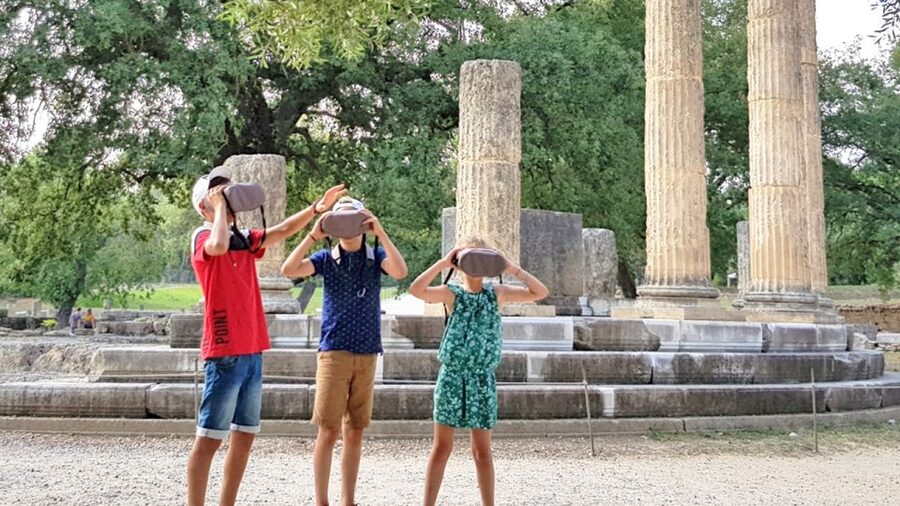
You’ll pick up the VR glasses at a local partner office you can find by searching Olympia back in time on Google Maps. The office is across from the main church, and that landmark makes it easier than hunting for a vague street address.
Before you go into the archaeological site, there’s a live demonstration and quick instruction on how to use the VR glasses and the audio guide. This is worth paying attention to. The better you understand how the system expects you to walk and select the right view, the smoother your time becomes once you’re among the stones.
Bring a passport or ID card, plus comfortable shoes. You’ll be moving around an outdoor site, and Olympia is not designed for flip-flops. Late arrivals are a real issue too. If you show up more than 45 minutes late, the booking is canceled without a refund, so plan travel time like you mean it.
Staff language support is broad, and the audio guide is available in Dutch, French, English, German, Spanish, Italian, and Greek. If you’re not traveling with English as your first language, this is one of those tours that actually feels considerate, since both the narration and the support are in multiple languages.
How the VR Headsets Work at Olympia (GPS Guidance and Getting Your Bearings)
The headset route uses location guidance, so you’re not completely on your own trying to match what you see in the headset with the physical ruins. In practice, the system helps you move from one numbered area to the next.
Here’s the trick that makes it click: follow the direction cues, not your personal sense of where you are facing. Some people find the first few steps confusing, especially when they look around and the real site looks different from the headset view. Once you get the hang of it, it becomes much easier to line up the virtual view with the physical monument.
Audio timing is a key part of the experience. Even if the device needs a moment to recognize your position, you can still learn a lot by using the guidance to reach the physical sign that matches the narration you hear. The experience is designed so you can recover if you miss a step.
Also, expect the tech to do what tech does outdoors. One headset may shut down and need a quick reboot, or the system may require you to reorient the location a few times. The good news is support is built in, and replacements or assistance can happen fast if something acts up.
Finally, use the headset as a learning tool, not as a camera substitute. You won’t be producing normal vacation photos through VR. Treat it like a guided reconstruction you experience with your eyes, then take your real-world photos after.
The 15 Monument Route, and Why Each Stop Matters
You’ll follow a route that covers 15 iconic monuments. Not all of them are equally dramatic when you’re standing in the ruins. The VR reconstructions change that, because they show the “before” version: how buildings sat in space, what training looked like, and how ceremonies played out.
You’ll start in the training world. The Ancient Gymnasium comes first in the storyline, and the VR makes it easier to grasp that this was an active place, not just a courtyard. Athletes trained there with routines built around preparation for competition. Next comes the Palestra, where you see the training grounds tied to boxing and wrestling. This is where a lot of people suddenly understand Olympia as a full sports center, not only a single temple complex.
Then the tour shifts toward the crafts and sacred power behind the sanctuary. The Phidias Workshop is a standout conceptually because it frames craftsmanship as part of Olympia’s identity. You’re not just seeing a statue. You’re seeing the workshop and thinking about how monumental art was made and why it mattered at a religious sports site.
From there, the route builds toward the big emotional payoff: the Temple of Zeus and the statue moment. When you reach this section, you’re not meant to view the temple from outside and guess at scale. VR places you in the temple experience so you can understand how massive and imposing it was.
Finally, you move into the performance side of the Games. The Ancient Stadium is where the tour turns from “here’s what’s left” to “watch the action.” Athletes compete in the stadium, and you’re positioned like a spectator, with the finish-line feeling built into the experience.
Two more stops help you understand Olympia as a working city for crowds. The Nymphaeum of Herodes Atticus is shown fully restored, and it’s explained as a water solution for summer crowds during the Games. It’s a reminder that big events need infrastructure, even in ancient times.
The route ends with the Olympic Flame ceremony. In VR, it feels less like a random ending and more like the emotional bridge between ancient athletic ideals and the later symbolism of the Games.
More Olympia days to weigh up
- Olympia: The Famous VR Glasses Tour (+Audio Guide)
★ 5.0 · 329 reviews - Olympia: Archaeological Site & Museum E-Ticket & Audio Guide
★ 4.3 · 272 reviews - Athens: Acropolis Ticket with Optional Audio or Live Guide
★ 4.2 · 11,055 reviews - Athens: Cape Sounio & Poseidon Temple Trip with Audio Guide
★ 4.4 · 4,521 reviews
Temple of Zeus VR: The Statue Moment That Changes Everything
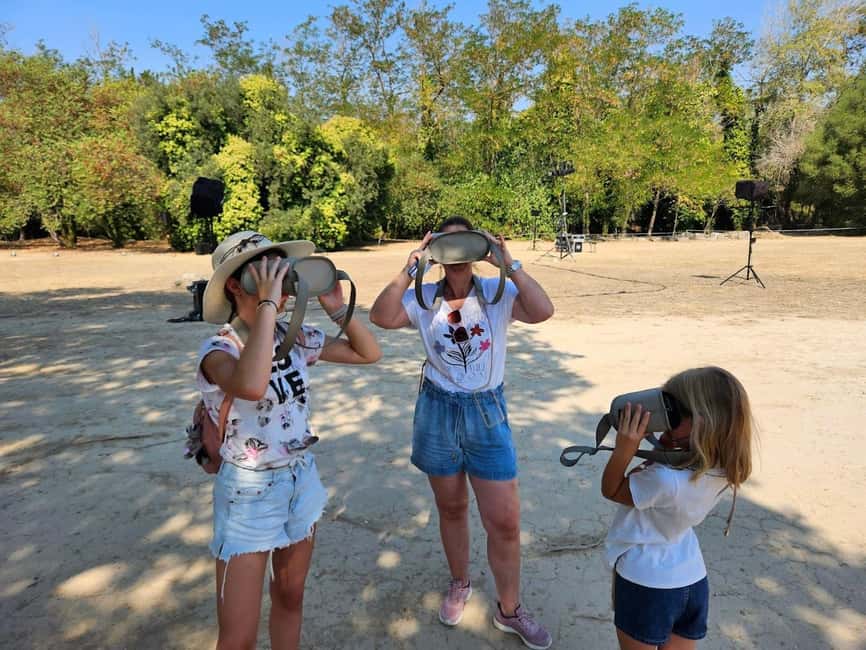
If you do only one thing at Olympia, do not skip the Temple of Zeus section. The ruins alone can be confusing. You see blocks, columns, and fragments. You can measure, but measurement doesn’t create the feeling of being inside a monumental sanctuary.
In VR, you virtually walk inside this colossal temple. You see the Statue of Zeus in its original splendor as part of the experience, not as a distant explanation. This is the point where the tour often feels most satisfying, because it answers a question you didn’t realize you had: how could this place have looked that grand when most of it is now gone?
What I like here, as a travel experience, is that VR doesn’t just show a pretty reconstruction. It connects the statue moment to Olympia’s identity. Olympia wasn’t only athletic. It was sacred theater, where art, religion, and sport reinforced each other.
Practical tip: go into this section with patience. Stand where it makes sense in the physical space, then let the headset do its alignment work. If you rush, you’ll spend more time fighting the tech than experiencing the architecture.
Ancient Stadium VR: Feeling the Games Instead of Reading About Them
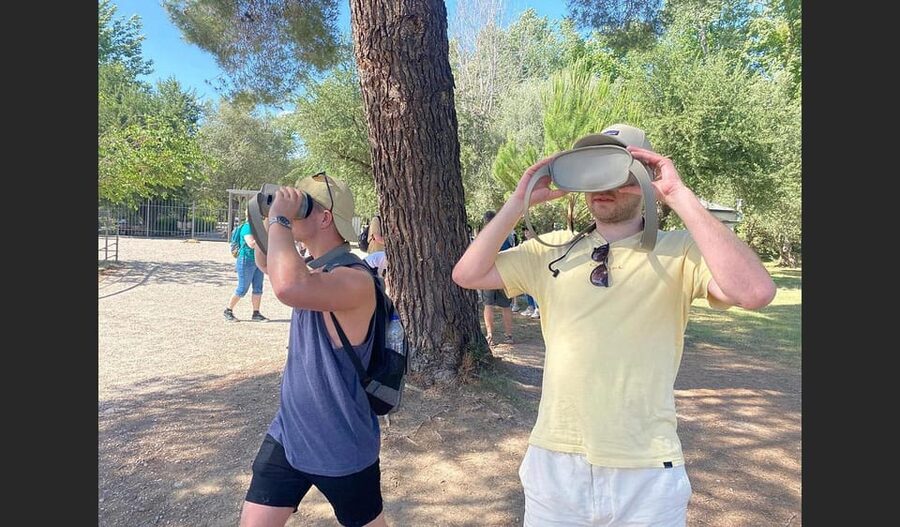
Olympia’s stadium is one of those places where reality can feel underwhelming at first glance. It’s not because it’s unimportant. It’s because ruins rarely communicate energy.
That’s why the Ancient Stadium VR sequence lands well. The experience transports you into a live competition. Athletes race and compete for glory, with the moment framed like you’re watching from the stands. The audio guide context helps you interpret what you’re seeing, so it feels like athletic ritual rather than random motion.
This is also where the tour becomes surprisingly engaging for teens. They may not care about long historical explanations, but they do care about how it looks and feels when people are competing. VR does a good job of letting you imagine the intensity of the Games in a way that static signage can’t.
If you want the best experience, keep your expectations realistic. This is VR, not a full motion simulator. You’re walking the site and watching the reenacted competition in your headset. But that limitation still works in your favor, since it keeps the experience grounded in the real location.
Nymphaeum of Herodes Atticus and the Olympic Water Problem
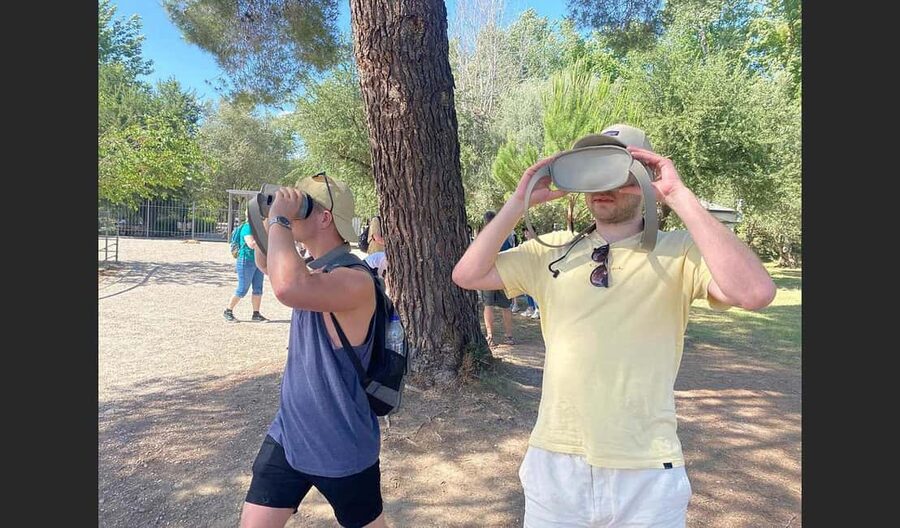
This is the stop that upgrades your understanding from famous to practical.
The Nymphaeum of Herodes Atticus is presented as a magnificent fountain restored in VR. And the narration connects it to a problem Olympia had during the Games: severe summer water shortages. In other words, the tour doesn’t treat architecture as decoration only. It frames it as problem-solving for thousands of spectators.
This detail is what makes Olympia feel like a living place. It’s easy to romanticize ancient Greece as temples and myths. The Nymphaeum section keeps things grounded by showing how a major crowd needed water to function.
In the physical site, you may not immediately grasp what a fountain could look like at full scale. VR fixes that by adding the missing forms and surfaces back into your mental picture. You then walk away with a better sense of how infrastructure supported the festival experience.
The Olympic Flame Ceremony: A Symbolic Finish With Meaning
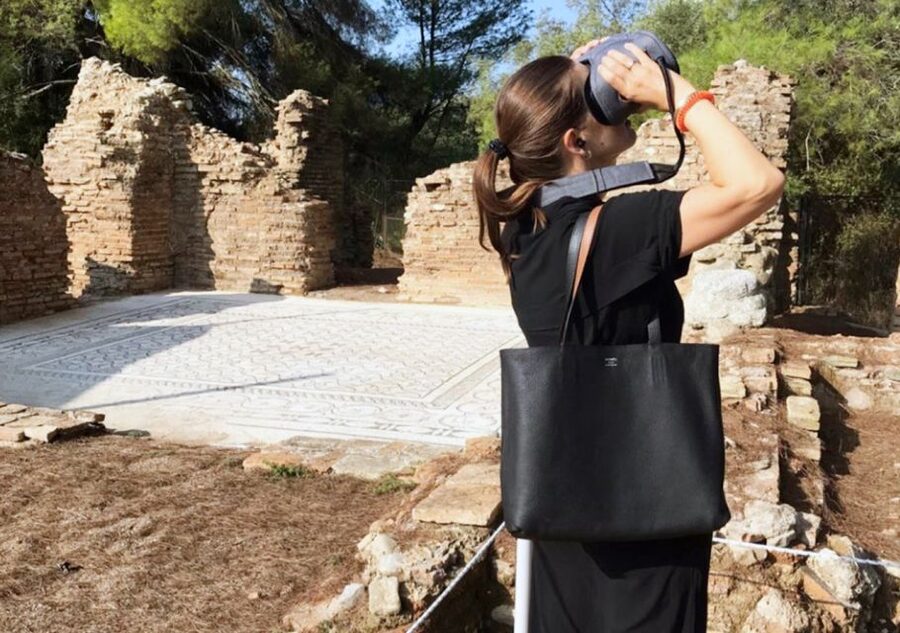
The ending matters. Some tours end with a generic stop. This one ends with the Olympic Flame ceremony, shown as a powerful ritual moment.
Even if you know the modern Olympic tradition, the VR presentation gives it context inside the ancient setting. That helps you leave Olympia with a clearer emotional connection to why the Games became symbolic in the first place.
This part also helps families. Kids often remember the finale scene, and it gives the tour a shape instead of feeling like a string of unrelated reconstructions.
Don’t rush this section. Let it land, then take your time exiting the route at your own pace.
Price and Value: Does 29 USD Make Sense at Olympia?
Let’s do the math the useful way.
The tour price is 29 USD per person for VR glasses rental, an audio guide, a live demonstration, and technical support and information. The Olympia site entry ticket costs 20 euros. In other words, your total spending is not just the VR portion.
So is it worth it? For me, the value comes from what you gain that you cannot get as quickly with self-guided ruins alone. Olympia is famous, but most visitors struggle to picture the complex buildings and how they related to everyday athletic preparation. The VR reconstructions turn scattered stones into a structured sanctuary, and the audio narration gives you context that signage often can’t.
There’s also a practical value angle. This format helps you avoid some of the crowd pressure that can build at major sites, since you’re moving independently along a guided route rather than locking into one pace with a big group.
Where I’d hesitate is if you only have a short time window and you already planned to spend most of your visit on museums. The VR rental period is time-limited, and you’ll want the headsets at the archaeological site first, then decide what else you can fit.
Who Should Book This VR Tour, and Who Might Not

This is a great fit if you want a clearer picture of Olympia fast. I’d especially recommend it if:
- You’re visiting with kids or teens, since the narration is designed to keep attention and the stadium sequence feels exciting
- You don’t want to spend your whole day trying to decode ruins using guesswork
- You prefer self-paced travel, where you can pause and move at your speed
It’s also ideal if you’ve been to other archaeological sites and felt like you were mostly staring at “stones and columns.” This one replaces guesswork with guided reconstruction.
It may be less ideal if you hate wearing tech or if you’re very sensitive to headsets and short-term orientation challenges. A few people report early confusion while the route guidance figures out your position, and you might need to slow down until the system and you sync up.
And if you’re the type who loves pure solitude at ruins, this still can work, but remember you’re wearing a device and following a route with timed expectations.
Should You Book This Olympia Back in Time VR Glasses Tour?
I think you should book it if your goal is to understand Olympia, not just see it. For many people, the biggest win is that you stop treating the site like a pile of remnants and start experiencing it like a sports sanctuary with buildings, statues, training routines, crowds, and ceremonies.
Do it if you value a guided experience with VR reconstructions plus an audio story, and if you’re okay adding the separate entry ticket cost. Skip it or swap plans if you only care about casual walking and you don’t want to deal with a headset route.
If you’re deciding this week, here’s my simple checklist: budget for the 20 euro entry ticket, wear comfortable shoes, plan your museum time carefully, and give the first few minutes a little extra patience. After that, the site tends to click into place in a way ruins alone rarely do.
FAQ
What is the duration of the Olympia VR glasses tour?
The experience lasts about 2 hours.
Is the entry ticket to Olympia included in the price?
No. The Olympia entry ticket costs 20 euros. Entry is free for EU visitors under 25 years old and non-EU visitors under 18 years old.
Where do I pick up the VR glasses?
Use Google Maps to search for Olympia back in time. The office is across from the main church.
What languages are available for the audio guide?
The audio guide is available in Dutch, French, English, German, Spanish, Italian, and Greek.
What should I bring with me?
Bring a passport or ID card, and wear comfortable shoes.
Is the experience wheelchair accessible?
Yes, the tour is listed as wheelchair accessible.
Just reviewed around Olympia
- Olympia – Half day Tour★ 5.0 · 130 reviews
- Ancient Olympia Half-Day Tour from Katakolo Cruise Port★ 4.5 · 228 reviews
- Olympia: Archaeological Site & Museum E-Ticket & Audio Guide★ 4.3 · 272 reviews
- Olympia: The Famous VR Glasses Tour (+Audio Guide)★ 5.0 · 329 reviews
- 3-Day Classical Greece Tour: Epidaurus, Mycenae, Nafplion, Olympia, Delphi★ 4.5 · 342 reviews
- 4-Day Classical Greece Tour: Epidaurus, Mycenae, Olympia, Delphi, Meteora★ 4.5 · 732 reviews
- Ancient Olympia: Archaeological Site and Museum Entry Ticket★ 4.3 · 555 reviews
- 4-Day Tour of Mycenae, Epidaurus, Olympia, Delphi & Meteora★ 4.8 · 168 reviews
Olympia Tours, compared.

4-Day Classical Greece Tour: Epidaurus, Mycenae, Olympia, Delphi, Meteora
Read our review →
Ancient Olympia: Archaeological Site and Museum Entry Ticket
Read our review →
3-Day Classical Greece Tour: Epidaurus, Mycenae, Nafplion, Olympia, Delphi
Read our review →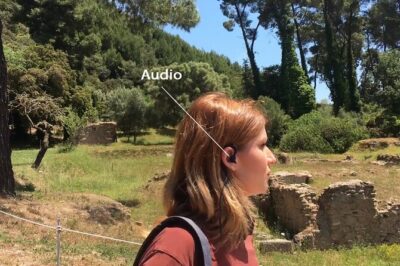
Olympia: The Famous VR Glasses Tour (+Audio Guide)
Read our review →
Olympia: Archaeological Site & Museum E-Ticket & Audio Guide
Read our review →
Ancient Olympia Half-Day Tour from Katakolo Cruise Port
Read our review →
4-Day Tour of Mycenae, Epidaurus, Olympia, Delphi & Meteora
Read our review →
Browse the lists this tour appears in