
What makes this tour interesting is how it turns Athens into a living classroom, where democracy and philosophy are explained on the same streets where they happened. I love the way guide Panos brings the ideas to life with storytelling that stays clear and funny, even when the topics get serious. I also like the route choice, it spends serious time around the Ancient Agora and the Pnyx, not just the usual Acropolis highlight.
One thing to consider: it is a walking tour in real city terrain, with rain or shine, and a longer finish up to Philopappos Hill, so wear comfortable shoes and expect some uphill walking.
Key things I’d circle before you go
- Panos-style storytelling that links philosophy and politics to specific monuments, not abstract lectures
- A route built around the civic core, including the Ancient Agora, Roman Agora area, and Pnyx Hill
- The Tower of the Winds stop, where you can picture a wind indicator and clock inside one octagonal structure
- Hadrian’s Library and views from Philopappos Hill to balance big ideas with real skyline time
- Small group size (max 15), which keeps the pace friendly and questions welcome
- Kids 14 and under join free, though the philosophical talk can be a lot for younger kids
Starting at the Statue of Theseus, then into Athens’ civic spine
You meet at the Statue of Theseus, opposite the train station, across the road. That location is handy because it is easy to spot, and it sets the tone: this is not a bus-and-brief-photo kind of tour. It is a walk that keeps the story moving.
From the first stretch, the tour frames Athens as a city of debate and learning. You are not only sightseeing. You are building a mental map of how public life, education, and ideas were woven together. The group stays small, up to 15 people, which makes it easier for the guide to pace the explanations around where you actually stand.
Timing is about 3.5 hours total. That is long enough to cover multiple major landmarks, but short enough that you still have energy left after. It is also rain or shine, and the tour notes only a few steps at the end. Still, Athens ground is uneven in spots, so comfortable shoes matter more than you think.
More Walking Tours in Athens
- Acropolis and Parthenon Guided Walking Tour
★ 5.0 · 4,755 reviews - Greek Food Walking Tour in Athens
★ 5.0 · 4,740 reviews - Athens: Guided Greek Food Walking Tour with Tastings
★ 4.9 · 2,859 reviews
Kerameikos, the Agora, and why Pericles’ Athens matters
The day takes you toward Kerameikos Archaeological Site, and it is a powerful opening. This area connects directly to Athenians’ public memory because it includes graves of prominent people for centuries. The tour also points out why Kerameikos is tied to famous political life, including the idea that Pericles gave his celebrated speech here.
That matters because it changes how you look at the rest of the walk. Instead of treating “democracy” as a textbook word, you start to see it as something tied to public gatherings, civic reputation, and the way speeches and ideas shaped real decisions.
From there, the focus lands on the Ancient Agora of Athens, the best-known example of an ancient Greek agora, and the place once used for political, commercial, administrative, and social activity. If you only visit the Acropolis, you miss the everyday engine that made ideas practical. Here you get the street-level version of civic life.
What I like about this part of the route is how it gives context while you move. You are not handed a list of facts. You get the why: why the Agora mattered, why people gathered, and how power and philosophy were connected through the act of arguing in public.
Practical note: admissions are not included for the Ancient Agora and other sites, so if your ticket plans feel tight, you may want to check what you will pay separately.
Monastiraki and Plaka, Athens between arguments
Between the big classical stops, you pass through Monastiraki and the edge of Plaka. This is not filler. It is the transition layer that helps you picture Athens as a lived-in city, not just a set of ruins.
Monastiraki is described as a flea market area with antique stores, and even a brief walk through it helps your eyes adjust to modern Athens. You start noticing the contrast: ancient stones still visible, modern shops and crowds doing their thing nearby.
Plaka is passed as a historical neighborhood with small scenic houses and narrow streets. This section is where the tour breathes. You catch glimpses that feel like a postcard, then you shift back toward political and educational landmarks. For me, this rhythm is part of the value. It stops the day from becoming one long museum-like procession.
Roman Agora area and the Tower of the Winds stop
One of my favorite segments is the stop at the Roman Agora area, plus the quick visit to the Tower of the Winds. Even if you think you know Athens, this is the kind of monument that can get overlooked when people rush for the Acropolis photos.
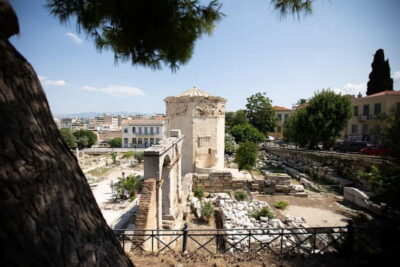
The Tower of the Winds is an octagonal marble tower inside the Roman Agora area. The tour explains its double job: a wind indicator and a clock. It also covers the idea of an early meteorological station and how it was used to forecast weather.
That detail is more than trivia. It shows how ancient Athens and its successors treated observation, measurement, and daily life as connected. Philosophy was not only about ethics and arguments. It also touched practical thinking, including the way people tried to read the world through patterns.
The walk here is short, but the explanation is memorable. If you like science history, or you enjoy the “how did they figure things out” angle, this is a highlight.
A different way to spend Athens time:
- Athens: Acropolis & up to 5 Archaeological Sites Combo Pass
★ 4.2 · 13,904 reviews - Athens: Acropolis Ticket with Optional Audio or Live Guide
★ 4.2 · 11,055 reviews - Athens: Acropolis, Parthenon & Acropolis Museum Guided Tour
★ 4.8 · 9,316 reviews - The Acropolis, Parthenon & Acropolis Museum Guided Tour
★ 4.7 · 8,493 reviews
Pnyx Hill, the place where democracy got loud
The tour heads to Pnyx Hill, a historic location for democracy. This is where the big theme of the day tightens. You are standing at a site tied to public decision-making, so the discussion of democracy feels anchored, not theoretical.
Pnyx is also a good example of why this tour earns its focus on philosophy and politics together. The guide links ideas to real civic behavior, how citizens discussed issues, and how those debates fit into Athens’ broader political evolution.
You also get a sense of how the city’s geography supports the story. From this part of the walk, you can look out across Athens and imagine how speeches and crowds would have worked in the open air. It is the kind of viewpoint that turns history into something your brain can “place.”
From a pacing standpoint, the Pnyx segment is a block of time (about 30 minutes walking and time on site as part of the itinerary). That is enough to slow down, absorb the context, and not feel rushed before the hilltop finale.
Hadrian’s Library, Roman Athens, and a different kind of learning
After Pnyx, you visit Hadrian’s Library, and it is a smart stop because it broadens the “learning” theme beyond the classic Greek era.
The tour frames it as part of the city’s education story. Even though this is Roman-era Athens, the connection to arts, education, and public intellectual life is what matters. The guide’s approach helps you see continuity: different rulers, similar appetite for culture and learning.
Hadrian’s Library also serves as a bridge into the final hill views. It gives you a chance to reset your eyes and then climb toward the last major viewpoint.
Just remember: admissions to Hadrian’s Library are not included in the tour price, so plan accordingly.
Philopappos Hill finale and the skyline moment
The tour ends around Filopappos Hill and Philopappos Hill views, and the timing is generous, with about 1.5 hours in that final area as part of the itinerary. That is the big payoff for many people, and you can feel why when the day reaches its high point.
The tour includes the ancient Greek mausoleum of Philopappos Monument, and the explanation of place and purpose ties back to the broader theme of public life and identity in ancient Athens. This is a good time to slow down and take in the city layout.
If you get winded, it is okay to pause. The tour is described as easy overall, but your body is still moving through Athens terrain. The final hill stretch is where good shoes and sensible pacing pay off.
The tour also passes by the Acropolis area, but the emphasis here is different. Instead of treating the Acropolis as the only star, you get a more rounded Athens where philosophy and democracy sit beside monuments that explain how people lived, argued, and learned.
Price and value for a small-group philosophy-and-politics walk
At $49 per person for about 3.5 hours, this tour sits in a midrange zone for Athens walking tours. What makes it feel like good value is the combination of small group size, live guide, and the specific thematic angle.
You are paying not just for access to landmarks, but for the connecting tissue. A guided walk that links philosophy, science ideas, and political regimes to the places you stand in can save you time, and it can also help you decide what you want to study more after.
Two value notes matter for families and first-timers:
- Group size is max 15, so you are not swallowed by a crowd.
- Children up to 14 join free, which can be a big deal when you are budgeting a half-day in Athens.
One caution on value: site admissions are not included. That means your total cost may rise depending on what tickets you choose or what you already plan to see.
Who this Athens tour fits best
This is a great match if you like big ideas with real-world anchors. If you enjoy learning how societies function, and you want the birthplace story of democracy explained through actual sites, you will likely click with this format.
It is also a strong choice as an early Athens experience. You return to the city later with a map in your head and a sense of what to notice. Several guides’ stories in this style can make the next day’s sightseeing easier because you already understand the “why” behind the stone.
It can work for families too. The tour notes that children up to 14 are welcome, and the reviews show kids can engage, though younger ones may find some philosophical parts heavy. If you are traveling with a child, you might consider bringing snacks and using the viewpoints to reset attention.
It is not suitable for people over 70, according to the tour notes. If you are in that age range and are unsure, you should look for tours with more limited walking or easier routes.
Practical tips so the walk feels good
Here are a few things I would do before you head out:
- Wear comfortable shoes with grip. Athens sidewalks can be slick or uneven.
- Bring a light layer for weather swings. The tour runs rain or shine.
- If you want the city views at the end to really land, plan to arrive with energy. The finish is a longer hill segment.
- If you care about tickets, double-check which sites need paid entry so you do not get surprised mid-walk.
Also, keep your expectations aligned with the format. This is an easy walking tour in a time window of 3.5 hours, but it still covers multiple neighborhoods and landmark clusters.
Should you book this Athens Philosophy and Democracy walking tour?
I think you should book it if you want more than photos. This tour is built for people who enjoy connecting political history and philosophy to where it actually happened, and it does that with a guide-led story that stays lively.
It is especially worth it if you:
- want a solid first look at Athens beyond the Acropolis,
- like civic history, science-as-observation, and how ideas shape society,
- value small groups and a guide who keeps things understandable.
Skip it if you want a mostly relaxing, low-effort sightseeing loop, or if long hill walking will be a problem for you. Admissions not included can also add to the budget, so factor that in.
If your goal is to leave Athens with a clearer sense of how democracy and philosophy grew from daily public life, this tour is one of the most direct ways to get there.
FAQ
Where do we meet for the Athens Philosophy and Democracy walking tour?
You meet in front of the Statue of Theseus, opposite the train station, across the road.
How long is the tour?
The tour duration is 3.5 hours.
What is the group size?
The group is limited to a maximum of 15 people.
Is there a live guide?
Yes, the tour includes a live guide speaking English.
Are site admissions included in the price?
No. Admissions for Athens, Hadrian’s Library, Roman Agora, Tower of the Winds, and the Ancient Agora are not included.
Is the tour walk long or strenuous?
It is listed as an easy tour with a few steps at the end, but you should wear comfortable shoes and be ready for a full walking route.
Does it run in rain?
Yes, the tour runs rain or shine.
Is the tour suitable for older adults?
It is noted as not suitable for people over 70.
Do children get a discount?
Children up to 14 years old join for free.
Is free cancellation available?
Yes, you can cancel up to 24 hours in advance for a full refund.
Just reviewed around Athens
- Athens Airport Arrival Transfer to Hotels or Addresses in Athens★ 3.5 · 45 reviews
- Luxury Catamaran Sunset Semi-Private & Greek Gastronomy in Athens★ 5.0 · 45 reviews
- Port Transfer★ 5.0 · 45 reviews
- Private Luxury Tour: Unveiling the Sacred Mysteries of Eleusis★ 5.0 · 45 reviews
- Acropolis Private Wine Tasting @ Finewine store★ 5.0 · 46 reviews
- Delphi, Thermopylae full day private tour from Athens★ 4.9 · 46 reviews
- From Athens: City & Corinth Guided Day Tour★ 4.8 · 46 reviews
- Ancient Corinth Half-Day Private Tour from Athens★ 5.0 · 46 reviews
Walking Tours, compared.


Acropolis monuments & Parthenon Walking Tour with Optional Acropolis Museum
Read our review →
Knossos: Knossos Palace Skip-the-Line Guided Walking Tour
Read our review →
Acropolis, Parthenon & Athens Old City Heritage Walking Tour
Read our review →
Athens Authentic Greek Food Walking Tour (Small Group)
Read our review →Browse the lists this tour appears in