Reviewed · ATHENS TOURS
Philosophy and Democracy tour of Athens
Athens works best when you stop treating it like a photo set and start treating it like a living classroom. This Philosophy and Democracy tour gives you a guided route through the places tied to debate, law, and civic life, with a clear focus on how ancient Athens influenced modern democracy.
I love the small group size (max 15), because questions actually land and you keep moving at a human pace. I also love the guide’s philosophy angle, using the sites to explain ideas you might hear in a textbook, but here you see the real geography. One consideration: it is still a walking tour, so comfortable shoes matter, and you will want to handle sun and hills around the Agora and Pnyx.
Key highlights you will feel right away
- Max 15 travelers, so you get more attention, not just a loud group lecture
- Phrased for real people, with conversations that connect philosophy and democracy to modern life
- Kerameikos and the Pericles thread, starting where Athens buried its own and remembered its values
- Iconic clock and weather tech at the Tower of the Winds, plus a simple way to visualize how it worked
- Pnyx views and the cradle of democracy, where civic decisions happened
- Practical stops in Plaka, with time for a scenic neighborhood pause
Philosophy and democracy in Athens, not just another archaeology walk
What makes this tour different is the theme. You are not only seeing major monuments, you are using each stop to answer one big question: how did people learn to govern themselves, and what did they argue about along the way?
You get the ancient-to-modern comparison built into the walk, so the story stays on track. That matters in Athens because the city is layered, fast, and easy to get lost in. Here, the guide keeps linking the dots, from spaces where debate happened to places tied to key leaders and thinkers.
The pacing also helps. The stops are timed in short bursts, so you are not stuck for ages in one spot with the crowd glare. You also mix in a free market stroll and multiple open-air areas. That combo makes it easier to stay engaged, even if you are not the type who wants museum hours.
More days around Athens:
- Athens: Acropolis & up to 5 Archaeological Sites Combo Pass
★ 4.2 · 13,904 reviews - Athens: Acropolis Ticket with Optional Audio or Live Guide
★ 4.2 · 11,055 reviews - Athens: Acropolis, Parthenon & Acropolis Museum Guided Tour
★ 4.8 · 9,316 reviews
Meeting Panos: the guide makes the ideas click
The reviews are consistent: the guide, Panos, is the reason this tour feels sharp and memorable. People highlight how he teaches complex concepts clearly, with timing and humor, and how he can keep explanations understandable while still covering serious material.
Another practical plus is volume and clarity. Multiple reviews mention that Panos spoke loudly and clearly, so you likely will not need earphones for sound. In a city where walking tours often feel like you are guessing half the time, that alone is worth something.
You also get question time. This is one of those walks where you can ask, stop, and get a direct answer. With a max of 15 travelers, the guide can actually respond, rather than moving on before you catch up.
Kerameikos Archaeological Site: Pericles spoke near a cemetery
Stop 1 is Kerameikos Archaeological Site, and it is chosen on purpose. Kerameikos means ceramic, because workshops clustered here. Later, it became the cemetery of Athens for many centuries, so it carries a different emotional weight than a temple ruin.
This is where the tour makes democracy feel human. You connect the place to the story of Pericles and his famous Epitaph speech for the first casualties of the Peloponnesian War, where he praises the virtues of democracy and the Athenians’ way of life. That framing changes how you look at the ground. You are not just seeing stones, you are seeing values being defended.
Practical note: the time here is about 15 minutes, and an admission ticket is not included. If you want full access, plan for that cost. If you simply want the meaning and context, you can still appreciate the area quickly.
Flea market stroll and Roman Athens: Hadrian’s Library and the Roman Agora
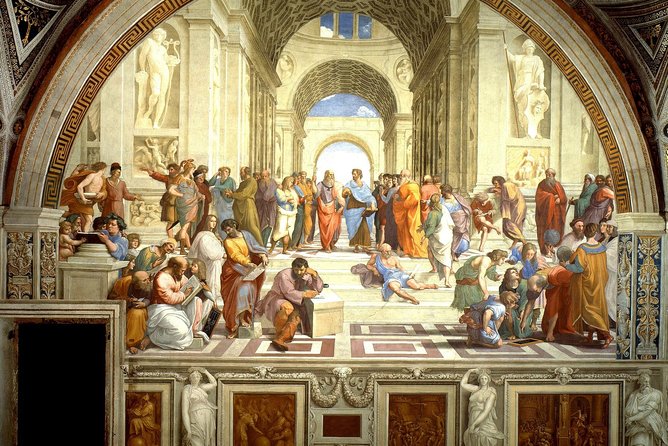
After Kerameikos, you shift into a lighter rhythm with a flea market walk. It is brief, about 15 minutes, and admission is free. This is a smart reset. You go from civic ideals and war memory to everyday street life, and it helps the rest of the route feel less like a history march.
Then the tour turns to Roman Athens.
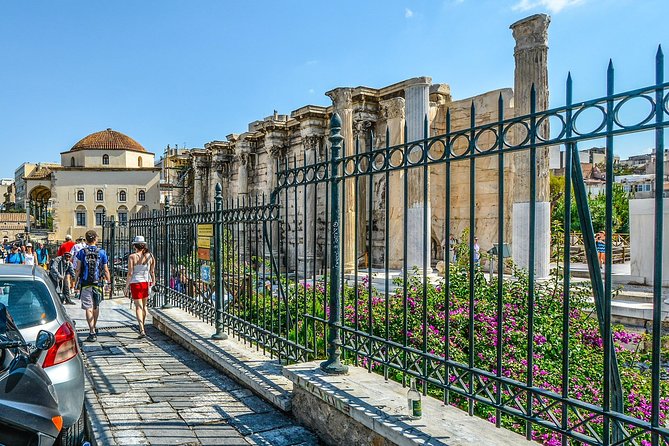
Hadrian’s Library is Stop 3, created by Roman Emperor Hadrian in AD 132 on the north side of the Acropolis of Athens. Even if you are not a Roman architecture fan, it is a good stop because the guide can show how later rulers reused older prestige spaces in Athens. It also helps your brain switch from Greek institutions to the way empire handled learning and public buildings.
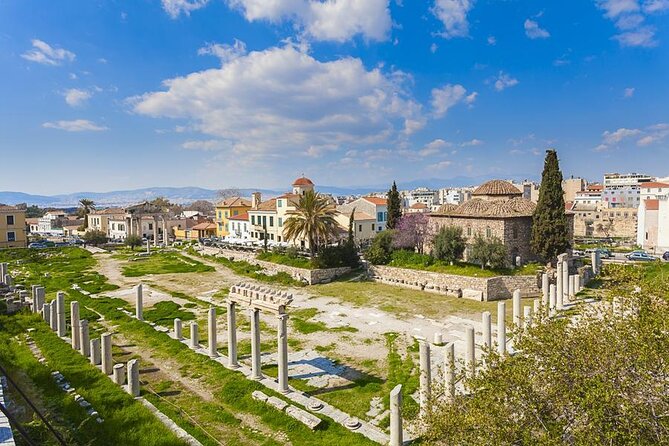
Stop 4 is the Roman Agora. It sits north of the Acropolis and east of the Ancient Agora. That positioning helps you understand how the city’s center shifted over time, without needing a map lecture.
Admissions are not included for these stops, so expect some site entry costs if you go in fully. On the upside, the times are short, so you are not stuck waiting around.
A different way to spend Athens time:
- The Acropolis, Parthenon & Acropolis Museum Guided Tour
★ 4.7 · 8,493 reviews - Athens: Cape Sounion & Poseidon Temple Sunset Half-Day Trip
★ 4.8 · 8,241 reviews - Acropolis: Premium Acropolis and Parthenon Guided Tour
★ 4.8 · 5,208 reviews - Athens: Mythology of Delphi, Museum and Arachova Guided Tour
★ 4.7 · 5,102 reviews
Tower of the Winds: Athens’ Big Ben for wind and weather
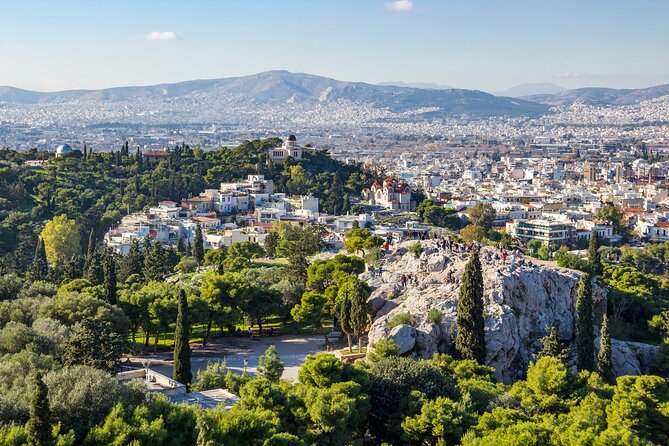
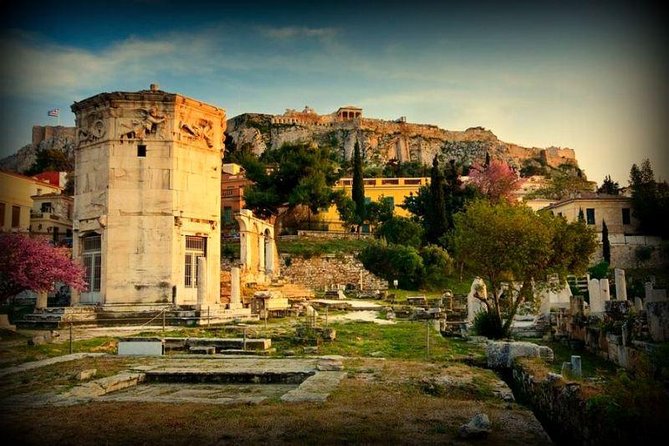
Stop 5 is the Tower of the Winds, and it is one of those Athens sights that most people skip because it is not on every postcard. The octagonal building was made by the astronomer Andronicus of Kyrristos in the 1st century BC.
The tour explains two functions that feel surprisingly modern: it was a wind indicator and also a clock. The guide describes it as the Big Ben of Athens, plus a meteorological station. One detail that sticks is how the timekeeping worked: the clock was solar, and in cloudy days a hydraulic mechanism produced a sound every hour. That hourly sound idea makes the technology feel less like trivia and more like city infrastructure.
This stop is only about 5 minutes, and admission is not included. If you want the best value from that short window, listen closely at the start, because the guide will point out what to notice fast. Also, watch your footing. It is a small area in an active walking circuit.
Ancient Agora and the Prison of Socrates: where ideas felt political
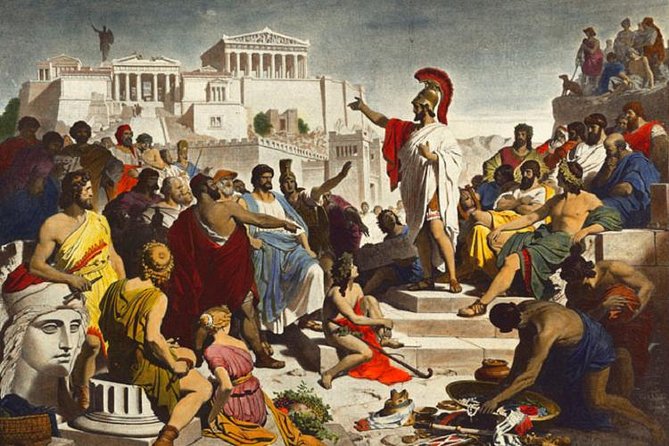
Stop 6 is the Ancient Agora of Athens, often the heart of the city. This is where the tour’s philosophy focus really earns its name. You connect the Agora to philosophers like Socrates and Plato, and to prominent politicians such as Solon, Themistocles, Pericles, and Thucydides. The guide also brings in key names from literature and drama, including Sophocles and Aristophanes.
The point is not to memorize a list. The point is to understand that discussions and debates were part of everyday civic life. The Agora is framed as the place where both prominent Athenians and simple citizens walked, talked, and argued about matters of politics and public decision-making.
Admission is not included here, and the stop is about 20 minutes. If you are hoping to enter, budget extra time and tickets accordingly. If you only stay outside, you still get the story thread and the layout context, which is what makes this tour worth it even when some site entries cost more.
Then you pause at Stop 7, the Prison of Socrates. The tour takes about 10 minutes and pays tribute to him. It is a short emotional moment that grounds the philosophy talk back into consequences. You get to see how Athens treated thinkers and how civic power could collide with individual ideals.
Pnyx Hill, Plaka streets, and that final major monument

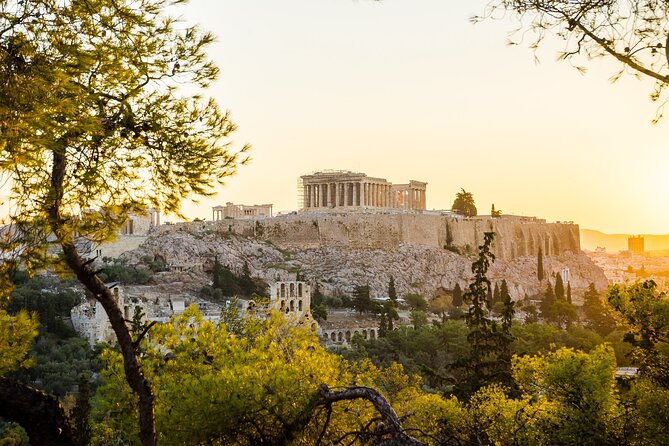
Stop 8 is Pnyx Hill, described as the cradle of democracy. The key idea here is simple: it was the first place where people took decisions for their future. This is the payoff for all the earlier talk about debate and civic values. Standing there, you get the sense that democracy was not abstract. It was a physical place with views and a public role.
You also get great views of the Acropolis and Athens. The stop is about 30 minutes, and admission is free, so you can slow down, take photos, and absorb it without feeling rushed.
After Pnyx, the walk includes time in the Plaka neighborhood, described as scenic, with small houses and narrow streets. That is a good place for a breather. Plaka often feels like the easiest part of Athens to enjoy, because the streets encourage strolling rather than sprinting.
The tour also includes time at Greece’s greatest monument for you to visit and admire, but the specific site name is not spelled out in the details I was given. Either way, this is your “big finish” time, so plan to pace yourself and save energy.
Price and tickets: what $50.81 buys you, and what it does not
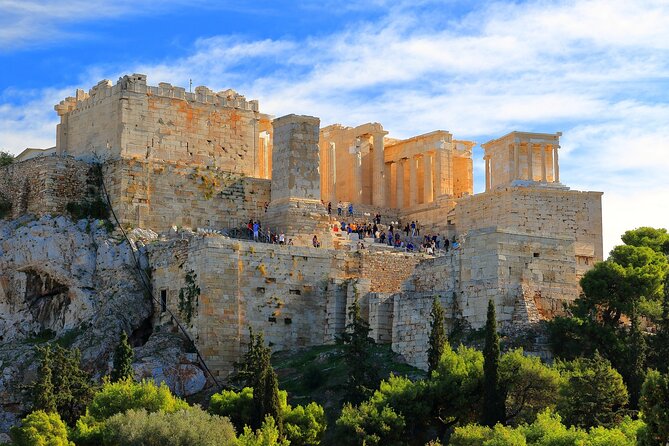
At $50.81 per person for about 3 hours 30 minutes, you are mostly paying for a guide, a tight theme, and a route that keeps you from wandering aimlessly.
This is not an all-in “everything entry included” deal. Several of the major stops list admission tickets as not included: Kerameikos, Hadrian’s Library, the Roman Agora, the Tower of the Winds, and the Ancient Agora. The good news is that multiple parts are free: the flea market walk, the Prison of Socrates tribute, and Pnyx.
So the value equation is pretty simple. If you plan to enter many of the paid sites, your total spend will climb, but you will also feel like you got the full guided circuit. If you mainly want the context and can be flexible on which entrances you prioritize, you can still get a lot out of the free stops.
One more practical value point: the group cap of 15 and the strong feedback on pacing means you are not paying for a crowded, rushed walk.
Who should book this Philosophy and Democracy tour?
Book it if you like your history with a question attached. You enjoy when a guide helps you connect the dots between ancient institutions and modern political life, and you want the Agora and Pnyx to mean something beyond architecture.
It also works well for families with older kids and teens. One review specifically mentions 11 and 15-year-olds enjoying the tour, even though it is described as targeted at adults. If your kids like big ideas and conversations, this is a smart way to keep them engaged.
If you already did an Acropolis-focused tour, this is a nice counterweight. You get the rest of Athens’ decision-making geography, plus the philosophy names that make people think.
Should you book it?
If you want Athens that makes you think, not just sightseeing that makes you stop, I would book this. The biggest reason is the guide, Panos, and the way the tour turns famous concepts into place-based stories. The second reason is the structure: short timed stops, a small group, free breathing room in places like the flea market and Pnyx.
Do it now if your schedule is fixed, because the tour is commonly booked about 36 days in advance. And do yourself a favor by bringing a bottle of water and wearing shoes built for walking.
FAQ
How long is the Philosophy and Democracy tour?
It runs for about 3 hours 30 minutes.
What is the price per person?
The price is $50.81 per person.
What language is the tour offered in?
The tour is offered in English.
How big is the group?
The tour has a maximum of 15 travelers.
Where do we meet and where does it end?
It starts at Statue of Theseus, Athens 105 55, Greece. It ends at Theorias 21, Athina 105 58, Greece.
Are entrance tickets included?
Admission tickets are not included for several stops, including Kerameikos, Hadrian’s Library, Roman Agora, Tower of the Winds, and the Ancient Agora. Some items are free, including the flea market walk, the Prison of Socrates tribute, and Pnyx.
Is this a walking tour?
Yes. It includes multiple stops in different parts of Athens, so wear comfortable shoes.
Is a mobile ticket provided?
Yes, the tour uses a mobile ticket.
What if weather is bad?
The experience requires good weather. If it is canceled due to poor weather, you will be offered a different date or a full refund. The tour can also be canceled if the minimum number of travelers is not met, with an alternative date/experience or a full refund.
Just reviewed around Athens
- Athens Highlights: Myths & Philosophers Walking Tour★ 5.0 · 125 reviews
- Sounio Sea Kayak Tour to the Temple of Poseidon full program★ 5.0 · 126 reviews
- First Access Acropolis Tour, Beat the Crowds, Enjoy the Parthenon★ 5.0 · 128 reviews
- Athens Half-Day Tour: Acropolis, Parthenon & All Major Landmarks★ 5.0 · 127 reviews
- Ancient Corinth, Mycenae, Epidaurus, Nafplio full day private tour from Athens★ 5.0 · 130 reviews
- Athens Cooking Class and Lunch in our beautiful garden in Greece★ 5.0 · 130 reviews
- Athens Highlights by E-Bike: Small-Group Historic Tour★ 5.0 · 131 reviews
- Athens Shore Excursion: Acropolis Walking Tour★ 4.5 · 131 reviews
Athens Tours, compared.
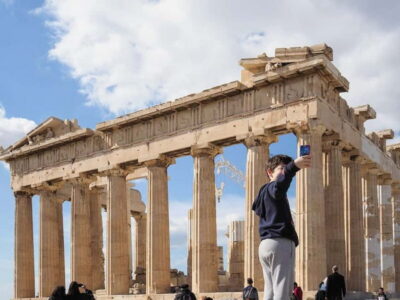
Acropolis & up to 5 Archaeological Sites Combo Pass
Read our review →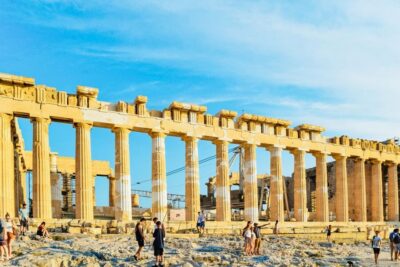
Acropolis Ticket with Optional Audio or Live Guide
Read our review →
Acropolis, Parthenon & Acropolis Museum Guided Tour
Read our review →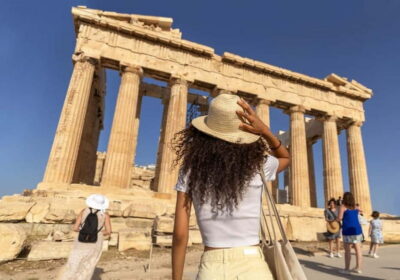
The Acropolis, Parthenon & Acropolis Museum Guided Tour
Read our review →
Cape Sounion & Poseidon Temple Sunset Half-Day Trip
Read our review →
Acropolis: Premium Acropolis and Parthenon Guided Tour
Read our review →
Mythology of Delphi, Museum and Arachova Guided Tour
Read our review →